Lesson 120 minYou are hereRead
All-pass systems
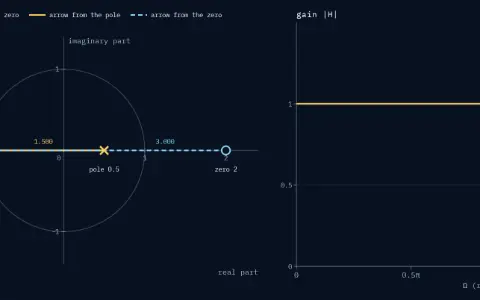
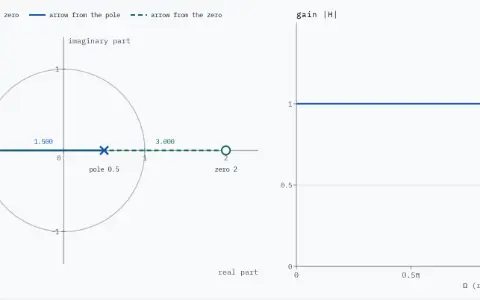
Put a zero at the mirror point of each pole and the gain stays at 1 for every frequency, while the group delay takes any shape you choose with the pole.
Chapter 17
Four lessons in Part VI, The z-transform and system analysis. Read them in order, or start anywhere: a prerequisite is a link, never a gate.
Start with 17.1![Z-plane with the unit circle and two zeros as open circles: one at −2, outside the circle (flipped from −0.5); the other at −1.25, outside the circle (flipped from −0.8). The gain curve |H| falls from 2.7 at Ω = 0 to 0.1 at π, the same for every flip. Stems of h[n] with square heads: 0.4, 1.3, 1. Faint open circles show the minimum-phase h, 1, 1.3, 0.4. Zeros inside: 0; h[0] = 0.40; phase at Ω = π: −360.0°.](/thumbs/minimum-phase-dark.webp)
![Z-plane with the unit circle and two zeros as open circles: one at −2, outside the circle (flipped from −0.5); the other at −1.25, outside the circle (flipped from −0.8). The gain curve |H| falls from 2.7 at Ω = 0 to 0.1 at π, the same for every flip. Stems of h[n] with square heads: 0.4, 1.3, 1. Faint open circles show the minimum-phase h, 1, 1.3, 0.4. Zeros inside: 0; h[0] = 0.40; phase at Ω = π: −360.0°.](/thumbs/minimum-phase-light.webp)
![Three stacked stem plots against sample n, from 0 to 23. Input x[n]: the pulse 0.25, 0.75, 1, 0.75, 0.25 at n = 4 to 8, centred at n = 6. Through z⁻³: the same pulse at n = 7 to 11, centre 9.00. Through the all-pass: it dips to −0.188 at n = 5, peaks at 0.977 at n = 8, then trails a tail that halves every sample; centre 9.00. A dashed line marks each centre. Faint open circles show the input moved 3 samples later: they sit exactly on the z⁻³ stems and miss the all-pass stems.](/thumbs/linear-phase-dark.webp)
![Three stacked stem plots against sample n, from 0 to 23. Input x[n]: the pulse 0.25, 0.75, 1, 0.75, 0.25 at n = 4 to 8, centred at n = 6. Through z⁻³: the same pulse at n = 7 to 11, centre 9.00. Through the all-pass: it dips to −0.188 at n = 5, peaks at 0.977 at n = 8, then trails a tail that halves every sample; centre 9.00. A dashed line marks each centre. Faint open circles show the input moved 3 samples later: they sit exactly on the z⁻³ stems and miss the all-pass stems.](/thumbs/linear-phase-light.webp)
After this chapter
The chapters either side, and the rest of Part VI in the library.