Skip to content

Discrete-time Fourier analysis

The fast Fourier transform

The fast Fourier transform (FFT) computes the DFT with far fewer multiplications by splitting the samples into even and odd and reusing each product. This topic shows the butterfly idea, other algorithms including prime lengths, fast convolution on blocks with overlap-add and overlap-save, and the Goertzel algorithm for single bins.

Lessons on this topic

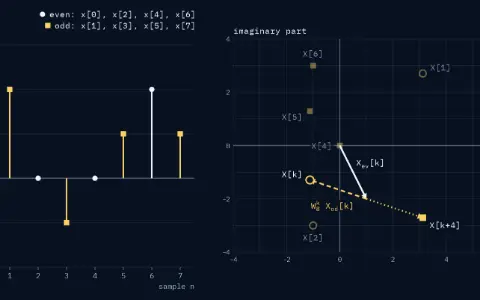
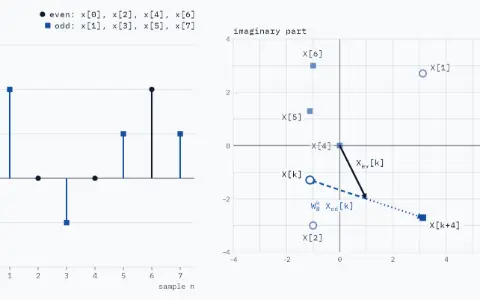
Samples x[n] = 1, 2, 0, −1, 0, 1, 2, 1 for n = 0 to 7 as stems; even samples marked with dots, odd samples with squares. Complex plane, k = 3: arrow X_ev[3] = 1−2j, then the product W₈ to the 3 times X_od[3] = −2.12+0.71j nose to tail, ending at X[3] = −1.12−1.29j (ring); flipped, it ends at X[7] = 3.12−2.71j (square). Finished outputs: X[0] = 6, X[4] = 0, X[1] = 3.12+2.71j, X[5] = −1.12+1.29j, X[2] = −1−3j, X[6] = −1+3j. Multiplies so far: 36.Samples x[n] = 1, 2, 0, −1, 0, 1, 2, 1 for n = 0 to 7 as stems; even samples marked with dots, odd samples with squares. Complex plane, k = 3: arrow X_ev[3] = 1−2j, then the product W₈ to the 3 times X_od[3] = −2.12+0.71j nose to tail, ending at X[3] = −1.12−1.29j (ring); flipped, it ends at X[7] = 3.12−2.71j (square). Finished outputs: X[0] = 6, X[4] = 0, X[1] = 3.12+2.71j, X[5] = −1.12+1.29j, X[2] = −1−3j, X[6] = −1+3j. Multiplies so far: 36.

Intermediate · 18 minYou are hereRead

The FFT

Split the samples into even and odd, reuse each product twice, and repeat. Watch an 8-point DFT shrink from 64 multiplies to 12.

Schematic of an FFT of length N = 31, prime: 31 sample rows. One stage column: radix 31, one box of 31 rows. Work 961 (direct 961).Schematic of an FFT of length N = 31, prime: 31 sample rows. One stage column: radix 31, one box of 31 rows. Work 961 (direct 961).

Advanced · 22 minYou are hereRead

More FFT algorithms

Split a DFT by any factor of N, rescue prime lengths with Bluestein’s chirp, pack two real signals into one FFT, and compare what libraries choose.

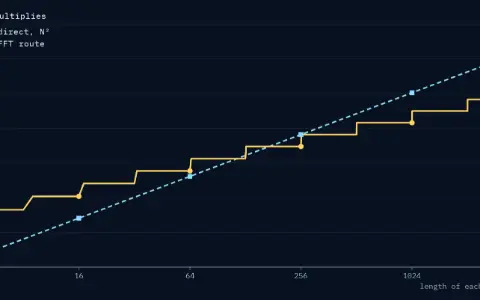
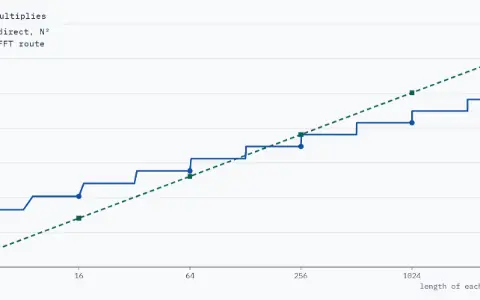
Real multiplies against the length of each signal N, both axes logarithmic, N from 4 to 4096. A dashed line for direct, N squared, and a solid staircase for the FFT route, drawn up to the current N. N = 4096: direct 16.8 million, FFT route 671 744 with an FFT of 8192. Cheaper: FFT route.Real multiplies against the length of each signal N, both axes logarithmic, N from 4 to 4096. A dashed line for direct, N squared, and a solid staircase for the FFT route, drawn up to the current N. N = 4096: direct 16.8 million, FFT route 671 744 with an FFT of 8192. Cheaper: FFT route.

Intermediate · 16 minYou are hereRead

Fast convolution

Convolve by multiplying FFTs, find the lengths where that is cheaper than flip and slide, and cut a long signal into blocks.

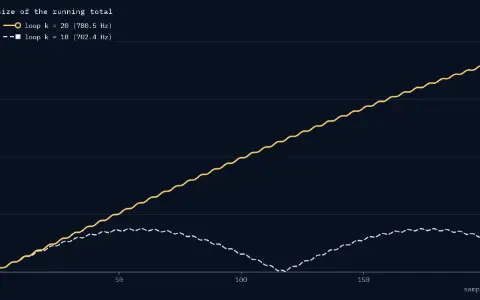
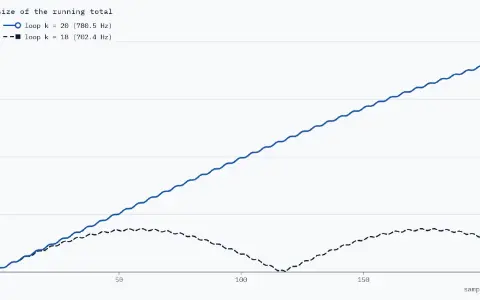
Plot of the size of the running total against sample n, 0 to 204, for a 770 Hz input. Up to sample n = 204: loop k = 20 (780.5 Hz), a solid line ending in a ring, is at 91.18; loop k = 18 (702.4 Hz), a dashed line ending in a square, is at 13.65.Plot of the size of the running total against sample n, 0 to 204, for a 770 Hz input. Up to sample n = 204: loop k = 20 (780.5 Hz), a solid line ending in a ring, is at 91.18; loop k = 18 (702.4 Hz), a dashed line ending in a square, is at 13.65.

Advanced · 20 minYou are hereRead

Goertzel and the chirp z-transform

Compute one DFT bin with a loop that rotates and adds, decode phone keys with eight such loops, then zoom into a narrow band of the spectrum.

Phasorium

Account

Sign inWith Google, GitHub or your email

Subjects

Site

Look