Skip to content

Chapter 5

LTI systems and convolution

Four lessons in Part II, Systems. Read them in order, or start anywhere: a prerequisite is a link, never a gate.

Start with 5.1
0 of 4 read4 on the essential pathabout 74 minutes

Lessons in this chapter

The system's reply to a single spike at n = 0: its impulse response h[n], for the echo.The system's reply to a single spike at n = 0: its impulse response h[n], for the echo.

Lesson 1 Essential18 minYou are hereRead

The impulse response

See why a linear, time-invariant system's reply to one spike is enough to predict its reply to anything.

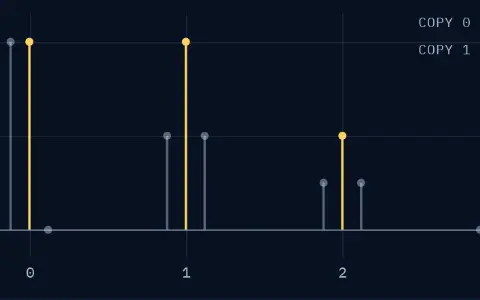
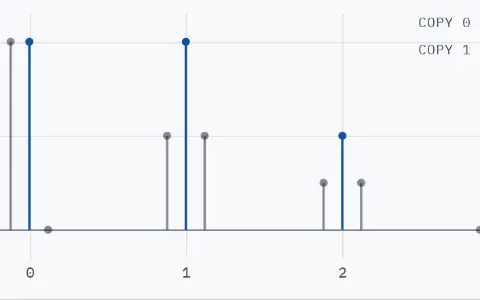
Two launched copies of h and their sum, with the sum highlighted.Two launched copies of h and their sum, with the sum highlighted.

Lesson 2 Essential20 minYou are hereRead

Discrete convolution

Give the "add up shifted copies of h" trick from 5.1 a name, a flip-and-slide picture, and a sum.

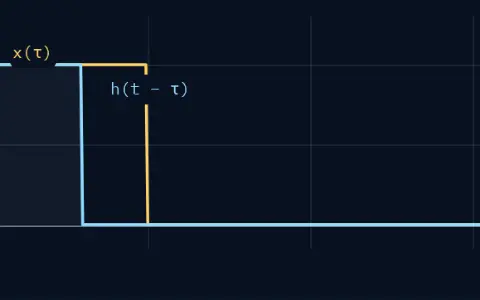
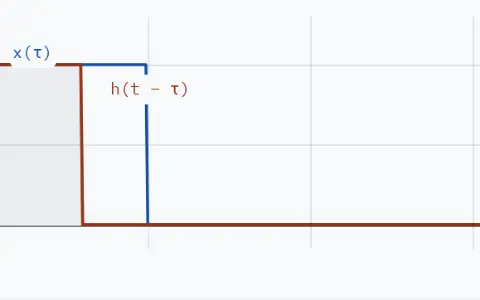
A fixed pulse x(τ) and a sliding pulse h(t − τ) at position t = 0.60. Their overlap is shaded; its area is 0.60.A fixed pulse x(τ) and a sliding pulse h(t − τ) at position t = 0.60. Their overlap is shaded; its area is 0.60.

Lesson 3 Essential18 minYou are hereRead

Continuous-time convolution

Turn the last page's convolution sum into a sliding overlap area, then use it on a real RC circuit.

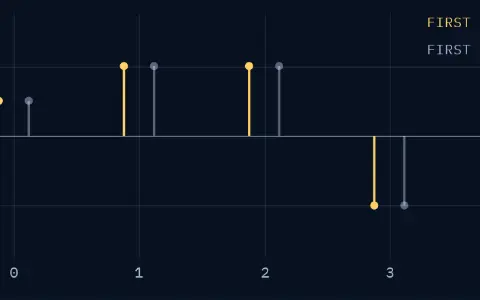
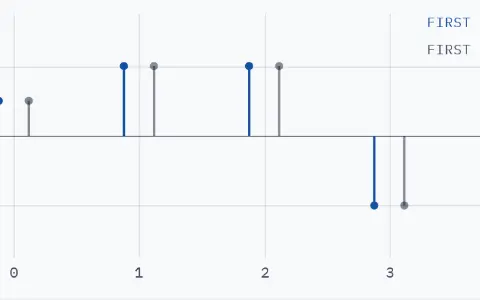
Output of the chain with the adder-pair first: 1, 2, 2, -2, -3; the other order gives the same values.Output of the chain with the adder-pair first: 1, 2, 2, -2, -3; the other order gives the same values.

Lesson 4 Essential18 minYou are hereRead

Properties of LTI systems

Reorder cascades and merge parallel systems with convolution's own algebra, read causality and stability off h, and see why a spinning signal passes through unchanged in rate.

After this chapter

Where to go next.

The chapters either side, and the rest of Part II in the library.

Phasorium
LibraryEvery lesson, in order

Parts

About Phasorium
Look