Skip to content

Systems

Systems described by equations

A system can be described by an equation as well as a block diagram. This topic runs difference equations one sample at a time, writes the RC circuit's differential equation and reads its time constant, and shows how first- and second-order systems set speed, overshoot and ringing.

Lessons on this topic

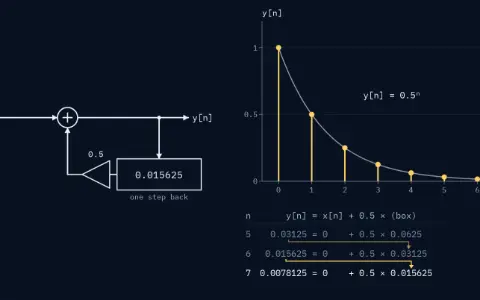
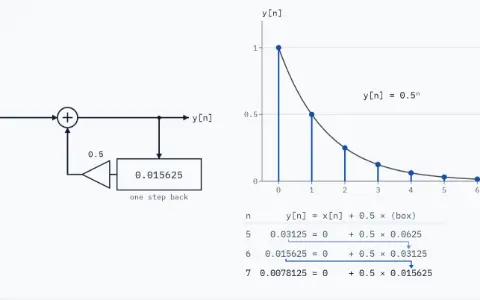
Animation: the loop y[n] = x[n] + 0.5 × y[n−1], worked out one sample at a time from a single 1 at n = 0. 8 outputs so far: 1, 0.5, 0.25, 0.125, 0.0625, 0.03125, 0.015625, 0.0078125. The delay box holds 0.015625. A smooth curve through the stem tops is labelled y[n] = 0.5 to the power n.Animation: the loop y[n] = x[n] + 0.5 × y[n−1], worked out one sample at a time from a single 1 at n = 0. 8 outputs so far: 1, 0.5, 0.25, 0.125, 0.0625, 0.03125, 0.015625, 0.0078125. The delay box holds 0.015625. A smooth curve through the stem tops is labelled y[n] = 0.5 to the power n.

Intermediate · 25 minYou are hereRead

Difference equations

Run a difference equation forward one sample at a time, compare a loop with no loop, and split an output into stored and pushed-in parts.

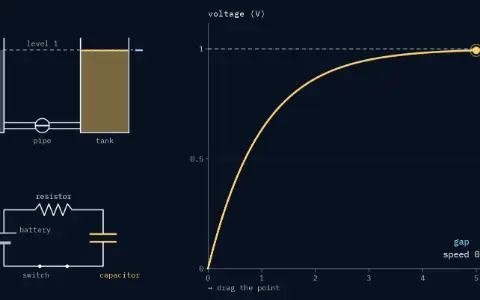
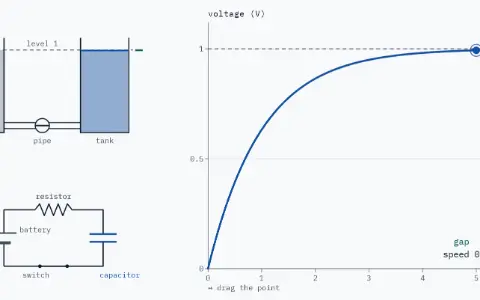
A tank fills through a narrow pipe from a reservoir at level 1. Beside it, the same story as a circuit: a 1 V battery charges a capacitor through a resistor, RC = 1 s. At t = 5.00 s the voltage is 0.993 V, the gap to 1 V is 0.007 V and the speed is 0.007 V/s.A tank fills through a narrow pipe from a reservoir at level 1. Beside it, the same story as a circuit: a 1 V battery charges a capacitor through a resistor, RC = 1 s. At t = 5.00 s the voltage is 0.993 V, the gap to 1 V is 0.007 V and the speed is 0.007 V/s.

Intermediate · 30 minYou are hereRead

Differential equations and analog systems

Write the RC circuit’s equation, read its time constant off a charging curve, split the answer in two, and see its discrete copy.

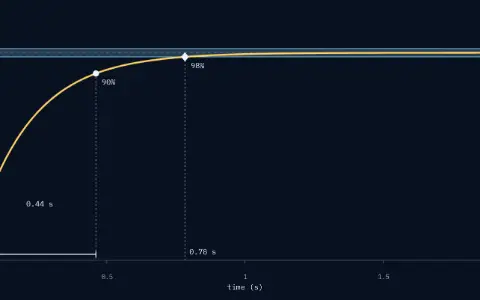
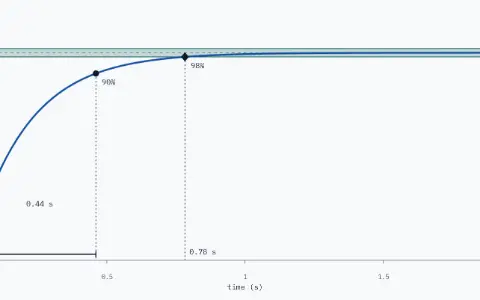
Step response y(t) of a first-order system with τ = 0.2 s, against time from 0 to 2 s. It rises from 0 toward 1. 10% point at 0.021 s. 90% point at 0.461 s. Bracket from the 10% to the 90% point: 0.44 s. Band from 0.98 to 1.02 drawn. 98% point, inside the band for good, at 0.78 s.Step response y(t) of a first-order system with τ = 0.2 s, against time from 0 to 2 s. It rises from 0 toward 1. 10% point at 0.021 s. 90% point at 0.461 s. Bracket from the 10% to the 90% point: 0.44 s. Band from 0.98 to 1.02 drawn. 98% point, inside the band for good, at 0.78 s.

Intermediate · 30 minYou are hereRead

First- and second-order systems

Read a system’s speed, overshoot and ringing from one or two numbers, and see why its poles come as a mirror pair.

Phasorium

Account

Sign inWith Google, GitHub or your email

Subjects

Site

Look