Skip to content

Chapter 7

Fourier series

Four lessons in Part III, Fourier analysis of continuous-time signals. Read them in order, or start anywhere: a prerequisite is a link, never a gate.

Start with 7.1
0 of 4 read2 on the essential pathabout 112 minutes

Lessons in this chapter

Animation: eight smooth spinning arrows, each riding on the tip of the one before, draw a wave. With all of them the wave has flat tops and sharp corners, like a square wave.Animation: eight smooth spinning arrows, each riding on the tip of the one before, draw a wave. With all of them the wave has flat tops and sharp corners, like a square wave.

Lesson 1 Essential25 minYou are hereRead

Signals as sums of sinusoids

Watch a square wave build itself from spinning arrows, hear how the recipe sets the timbre, and see why each arrow can be measured alone.

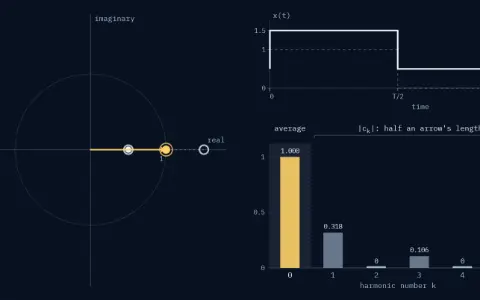
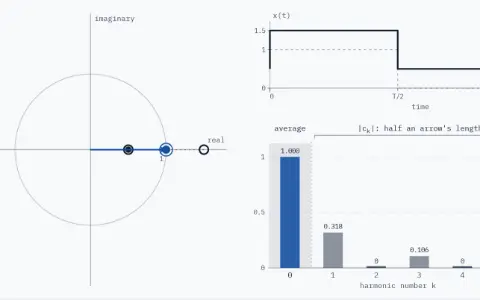
Winding machine at setting 0, on the 0-to-1 square wave lifted by 0.5. The traced point has gone a full period; the dot, the average of where it has been, is at 1. Bars stamped: average 1, size of c1 0.318, size of c2 0, size of c3 0.106, size of c4 0, size of c5 0.064.Winding machine at setting 0, on the 0-to-1 square wave lifted by 0.5. The traced point has gone a full period; the dot, the average of where it has been, is at 1. Bars stamped: average 1, size of c1 0.318, size of c2 0, size of c3 0.106, size of c4 0, size of c5 0.064.

Lesson 2 Essential35 minYou are hereRead

Fourier series coefficients

Turn the multiply-and-average trick into the Fourier series formula, write it three ways, read it as a line spectrum, and use symmetry and power.

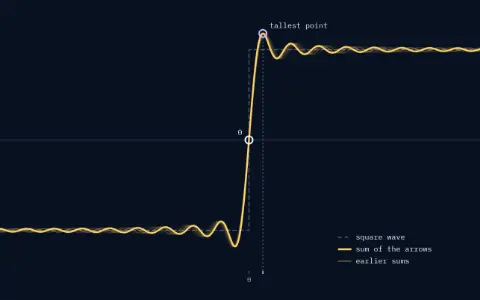
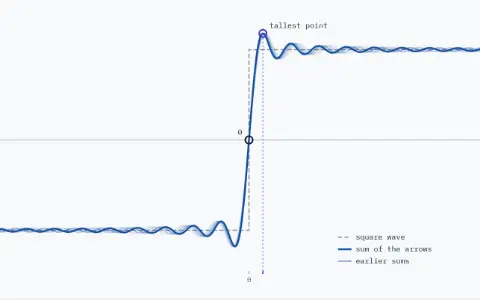
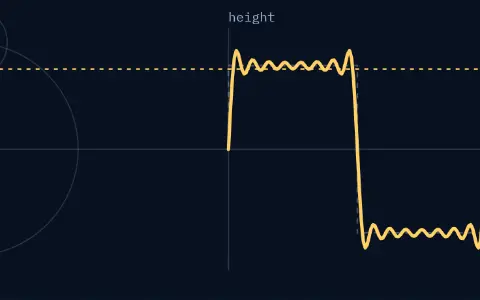
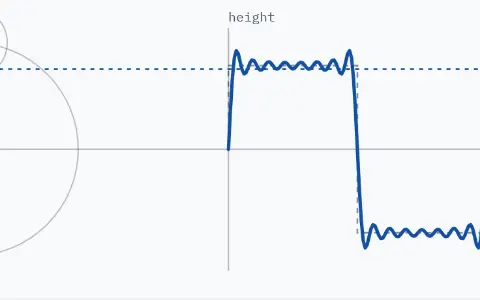
The ±1 square wave next to its jump at time 0, from −T/4 to T/4, dashed, and the sum of 20 arrows (harmonics 1 to 39). The tallest point is 1.179, at time T/80. Fainter behind it: the sums of 17, 18, 19 arrows. At the jump the sum is exactly 0.The ±1 square wave next to its jump at time 0, from −T/4 to T/4, dashed, and the sum of 20 arrows (harmonics 1 to 39). The tallest point is 1.179, at time T/80. Fainter behind it: the sums of 17, 18, 19 arrows. At the jump the sum is exactly 0.

Lesson 322 minYou are hereRead

Convergence and the Gibbs phenomenon

Stop the square wave's arrows after a few, and see which error shrinks, which stubborn bump does not, and why smoother waves need fewer arrows.

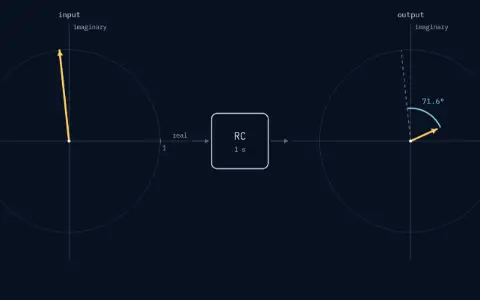
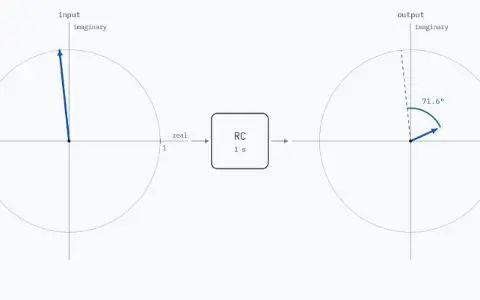
An input arrow of length 1 spinning at 3.0 radians per second goes through the RC circuit, RC = 1 second. The output arrow spins at the same rate, 0.316 as long and 71.6° behind the input. H = 0.316∠−71.6°.An input arrow of length 1 spinning at 3.0 radians per second goes through the RC circuit, RC = 1 second. The output arrow spins at the same rate, 0.316 as long and 71.6° behind the input. H = 0.316∠−71.6°.

Lesson 430 minYou are hereRead

Fourier series and LTI systems

Send a repeating wave through an RC circuit one harmonic at a time, see why every harmonic is turned down and turned back, and measure the distortion.

Phasorium
LibraryEvery lesson, in order

Parts

About Phasorium
Look