Skip to content

Fourier analysis

The Fourier transform

The Fourier transform extends the Fourier series to signals that do not repeat. This topic stretches a pulse train's period until its spectral lines merge into one curve, then covers the transform's properties, the transforms of common signals, and frequency response on a logarithmic Bode plot.

Lessons on this topic

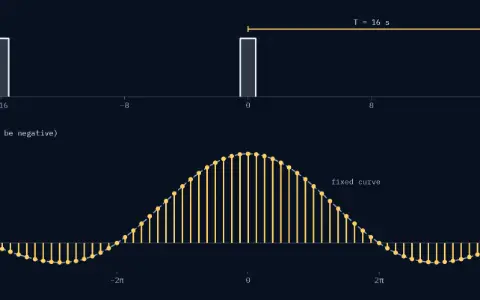
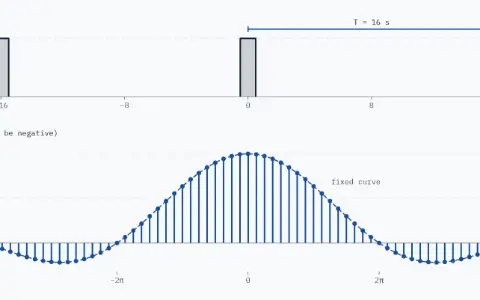
Unit pulses repeated every 16.000 s. Line spectrum from −4π to 4π rad/s: 65 lines, 0.393 rad/s apart, each multiplied by 16.000. Heights at 0.000, 0.393, 0.785, 1.178, 1.571, 1.963 rad/s: 1.000, 0.994, 0.974, 0.943, 0.900, 0.847. Every line stands on the same fixed curve.Unit pulses repeated every 16.000 s. Line spectrum from −4π to 4π rad/s: 65 lines, 0.393 rad/s apart, each multiplied by 16.000. Heights at 0.000, 0.393, 0.785, 1.178, 1.571, 1.963 rad/s: 1.000, 0.994, 0.974, 0.943, 0.900, 0.847. Every line stands on the same fixed curve.

Intermediate · 30 minYou are hereRead

From series to transform

Stretch a pulse train’s period until its lines crowd onto one curve, then read that curve, the Fourier transform, by winding, width and band.

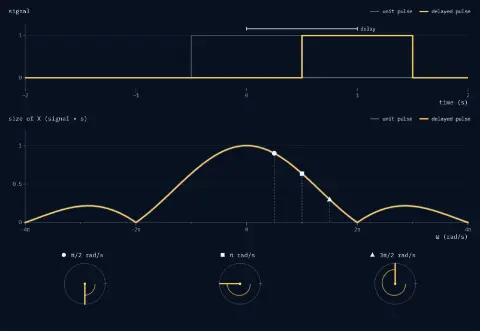
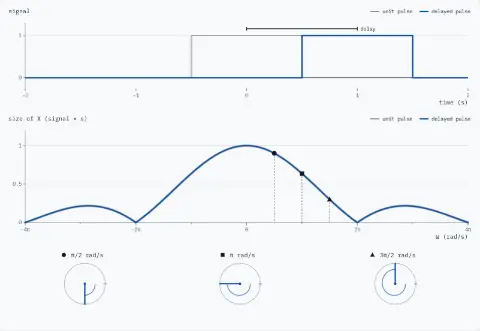
Time panel: the unit pulse delayed by 1 s, over a faint copy of the pulse at its start. Spectrum panel: the size of X against ω in rad/s, 1 at 0 rad/s with its first zeros at ±2π; it does not move and sits exactly on its faint copy. Dials: at π/2 rad/s turned by −90°, at π rad/s turned by −180°, at 3π/2 rad/s turned by −270°.Time panel: the unit pulse delayed by 1 s, over a faint copy of the pulse at its start. Spectrum panel: the size of X against ω in rad/s, 1 at 0 rad/s with its first zeros at ±2π; it does not move and sits exactly on its faint copy. Dials: at π/2 rad/s turned by −90°, at π rad/s turned by −180°, at 3π/2 rad/s turned by −270°.

Intermediate · 30 minYou are hereRead

Properties of the Fourier transform

Delay, squeeze, multiply, convolve and differentiate a signal, and read each change in its spectrum from one rule per operation.

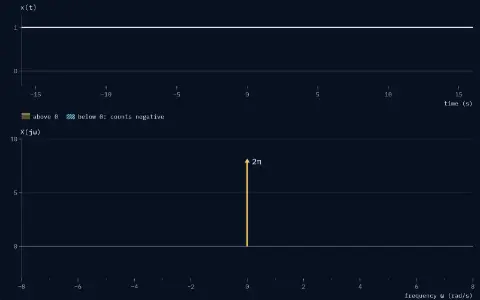
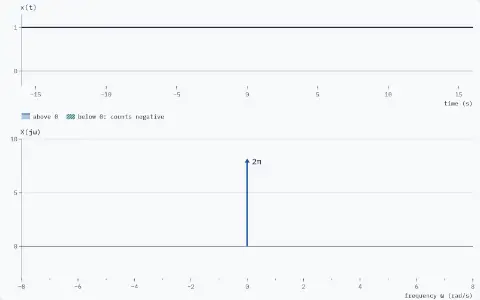
Time: a level of 1 that never ends. Spectrum: one arrow at 0 rad/s labelled 2π; area of the whole curve 6.283.Time: a level of 1 that never ends. Spectrum: one arrow at 0 rad/s labelled 2π; area of the whole curve 6.283.

Intermediate · 25 minYou are hereRead

Transforms of common signals

See why signals that never end have spikes in their spectrum, read a spike by its area, and build the standard transform table.

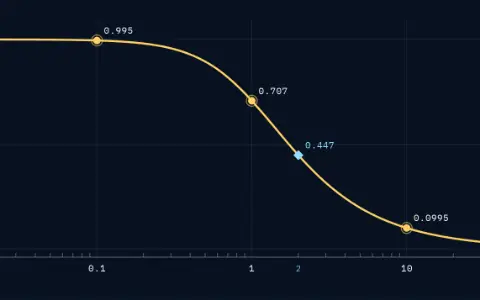
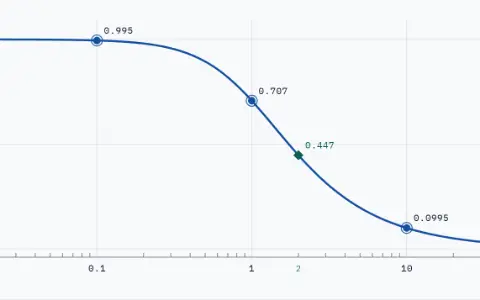
Gain of the RC circuit, RC = 1 s, against frequency on a logarithmic axis from 0.01 to 100 rad/s, with decade gridlines and minor ticks. Dots on the curve: 0.995 at 0.1 rad/s, 0.707 at 1 rad/s, 0.447 at 2 rad/s, 0.0995 at 10 rad/s.Gain of the RC circuit, RC = 1 s, against frequency on a logarithmic axis from 0.01 to 100 rad/s, with decade gridlines and minor ticks. Dots on the curve: 0.995 at 0.1 rad/s, 0.707 at 1 rad/s, 0.447 at 2 rad/s, 0.0995 at 10 rad/s.

Intermediate · 30 minYou are hereRead

Frequency response and Bode plots

Sweep a circuit across every frequency, read its gain and lag on a logarithmic Bode plot, and see why an ideal filter cannot be built.

Phasorium

Account

Sign inWith Google, GitHub or your email

Subjects

Site

Look