Skip to content

Multirate processing

Filter banks and wavelets

A filter bank splits a signal into bands and, in a perfect-reconstruction design, can rebuild it exactly because the aliases cancel. This topic covers the two-band case, uniform DFT banks and the MDCT, then wavelets, which keep splitting the low band to see fast changes sharply in time and slow ones in frequency.

Lessons on this topic

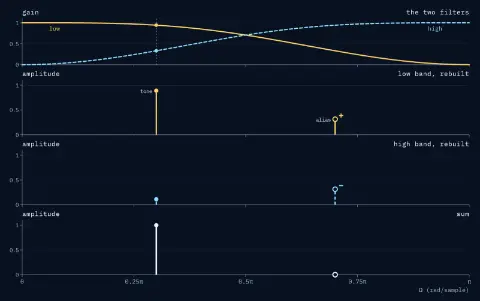
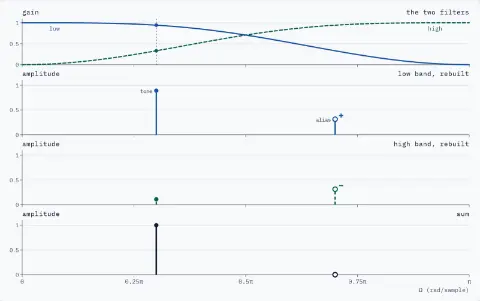
Four strips over frequency from 0 to π: the two filters, the low band rebuilt, the high band rebuilt, and their sum. The low filter, a solid curve, has gain 0.94 at 0.30π; the high filter, a dashed curve, has gain 0.33 there; they cross at 0.5π. Low band: the tone at 0.30π, a dot at 0.890, and the alias at 0.70π, an open ring at 0.313 marked plus. High band: the tone at 0.110 and the alias at 0.313 marked minus. Sum: the tone at 1.000 and no alias.Four strips over frequency from 0 to π: the two filters, the low band rebuilt, the high band rebuilt, and their sum. The low filter, a solid curve, has gain 0.94 at 0.30π; the high filter, a dashed curve, has gain 0.33 there; they cross at 0.5π. Low band: the tone at 0.30π, a dot at 0.890, and the alias at 0.70π, an open ring at 0.313 marked plus. High band: the tone at 0.110 and the alias at 0.313 marked minus. Sum: the tone at 1.000 and no alias.

Advanced · 20 minYou are hereRead

Filter banks

Split a signal into two bands at half the rate each and rebuild it exactly, because the aliases cancel; then DFT banks and the MDCT.

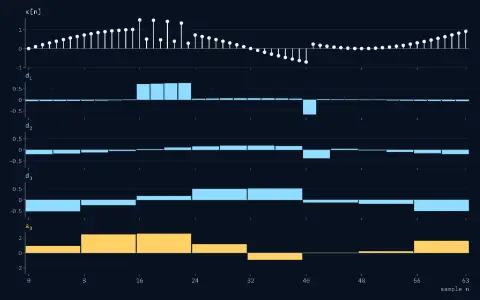
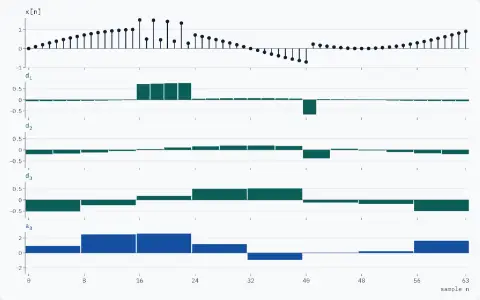
Five strips over sample n from 0 to 63: the signal x[n] as stems, then the details d₁, d₂ and d₃ and the approximation as bars, each bar as wide as the samples it covers. The signal x[n] runs from −0.707 to 1.500: a slow wave, a step at n = 41 and a burst of fast alternation at n = 16 to 23. Level 1 details, d₁: 32 bars; the burst's four at 0.7105 to 0.7484, the step's at −0.6605, every other at most 0.0693 in size. Level 2 details, d₂: 16 bars, the largest the step's, −0.3834. Level 3 details, d₃: 8 bars, from −0.5164 to 0.5164 where the wave is steepest; the step's is −0.1190. The approximation a₃: 8 bars with 81.62 % of the energy.Five strips over sample n from 0 to 63: the signal x[n] as stems, then the details d₁, d₂ and d₃ and the approximation as bars, each bar as wide as the samples it covers. The signal x[n] runs from −0.707 to 1.500: a slow wave, a step at n = 41 and a burst of fast alternation at n = 16 to 23. Level 1 details, d₁: 32 bars; the burst's four at 0.7105 to 0.7484, the step's at −0.6605, every other at most 0.0693 in size. Level 2 details, d₂: 16 bars, the largest the step's, −0.3834. Level 3 details, d₃: 8 bars, from −0.5164 to 0.5164 where the wave is steepest; the step's is −0.1190. The approximation a₃: 8 bars with 81.62 % of the energy.

Advanced · 22 minYou are hereRead

Wavelets

Split the low band again and again: fast changes are seen sharply in time, slow ones in frequency, and dropping small coefficients removes noise.

Phasorium

Account

Sign inWith Google, GitHub or your email

Subjects

Site

Look