Skip to content

Vectors and matrices

Vectors

A vector is an arrow with a length and a direction, and equally a list of numbers. This topic adds and scales arrows, asks which points a few arrows can reach by combining them, and measures length and angle with the dot product.

Lessons on this topic

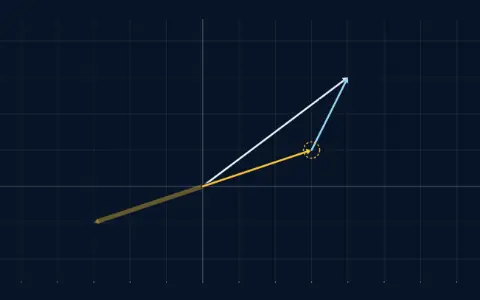
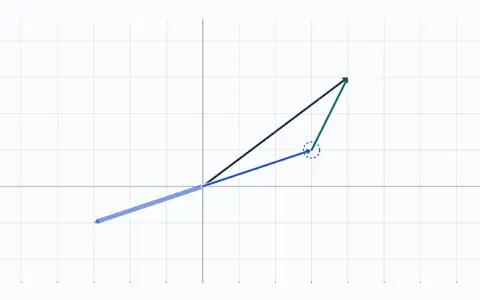
Animation: adding arrows tip to tail, v = (3, 1) and w = (1, 2). W starts at the tip of v. The sum v + w = (4, 3) runs from the origin to the end of w. A faded copy of v is −v = (−3, −1).Animation: adding arrows tip to tail, v = (3, 1) and w = (1, 2). W starts at the tip of v. The sum v + w = (4, 3) runs from the origin to the end of w. A faded copy of v is −v = (−3, −1).

Beginner · 15 minYou are hereRead

Vectors

Read a vector as an arrow and as a list of numbers, add arrows tip to tail, scale them, and see a sound clip as one long vector.

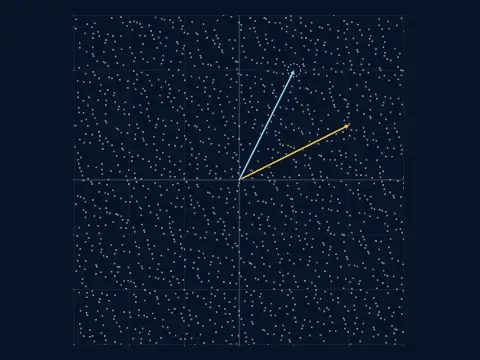
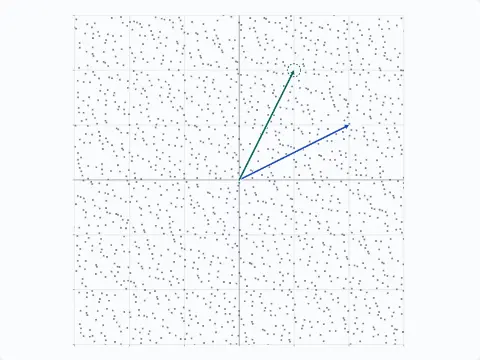
Animation: dots land at c times v plus d times w, v = (2, 1) and w = (1, 2), for weights between −3 and 3. 4800 dots have landed. The combinations fill the whole plane.Animation: dots land at c times v plus d times w, v = (2, 1) and w = (1, 2), for weights between −3 and 3. 4800 dots have landed. The combinations fill the whole plane.

Beginner · 18 minYou are hereRead

Linear combinations and span

Stretch two arrows and add them to see every place they can reach, and spot when a second arrow adds nothing new.

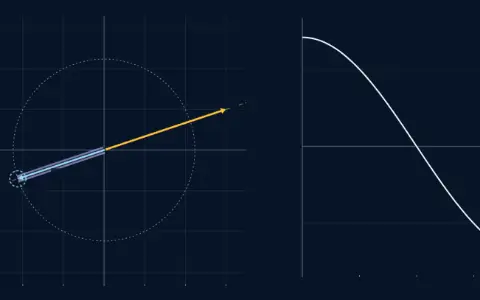
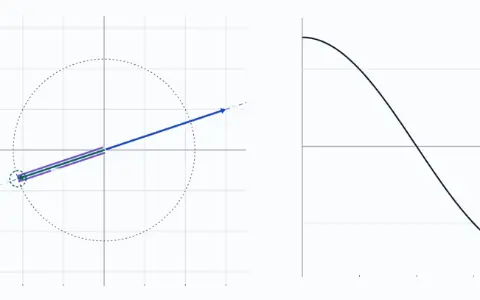
Animation: w turns round and casts a shadow on the line of v = (3, 1). W = (−2.121, −0.707), 180° from v. The shadow is −2.236 long, behind the origin, and v · w = −7.071.Animation: w turns round and casts a shadow on the line of v = (3, 1). W = (−2.121, −0.707), 180° from v. The shadow is −2.236 long, behind the origin, and v · w = −7.071.

Beginner · 22 minYou are hereRead

Length and the dot product

Measure an arrow’s length, see the dot product as a shadow, and use it to find angles and right angles in any number of dimensions.

Related topics

Where to go next.

Phasorium

Account

Sign inKeep your place on any device

Subjects

Site

Look