Skip to content

Solving linear equations

Linear systems

A system of linear equations can be read as lines or planes that meet, or as columns combined to reach a target. This topic solves systems by elimination, says when an inverse exists, records elimination as the LU factorisation, and introduces transposes and permutations.

Lessons on this topic

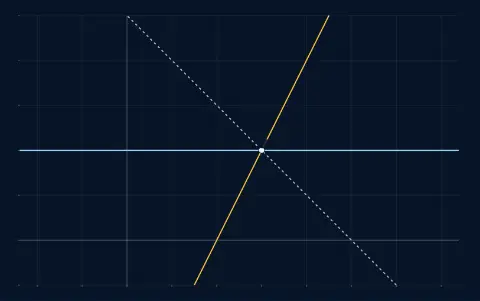
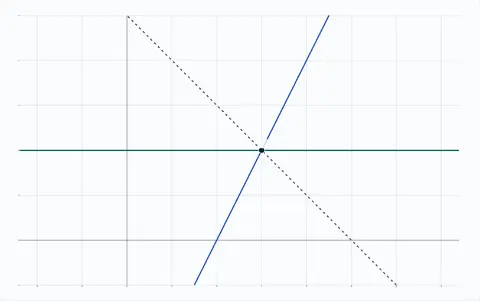
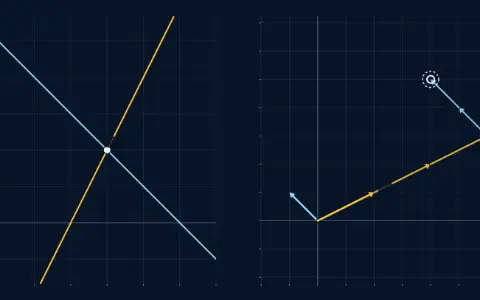
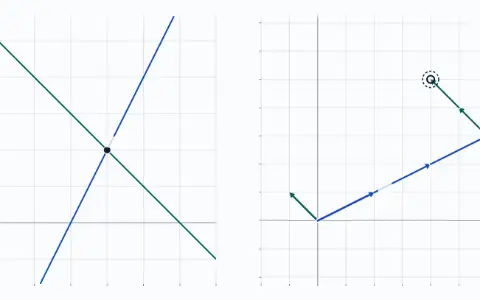
Two pictures of the equations 2x − y = 4 and x + y = 5: two lines, and the columns (2, 1) and (−1, 1) with the target b = (4, 5). The lines cross at (3, 2), and that mix of the columns ends on b.Two pictures of the equations 2x − y = 4 and x + y = 5: two lines, and the columns (2, 1) and (−1, 1) with the target b = (4, 5). The lines cross at (3, 2), and that mix of the columns ends on b.

Beginner · 25 minYou are hereRead

Two pictures of a linear system

See two equations as two crossing lines and as two arrows mixed to reach a target, and tell one answer, none or infinitely many apart.

The lines 2x − y = 4 and x + y = 5 cross at (3, 2). The second line is now 1.5y = 3.The lines 2x − y = 4 and x + y = 5 cross at (3, 2). The second line is now 1.5y = 3.

Intermediate · 30 minYou are hereRead

Elimination

Subtract one equation from another until the system is a staircase, solve it from the bottom up, and watch the crossing point never move.

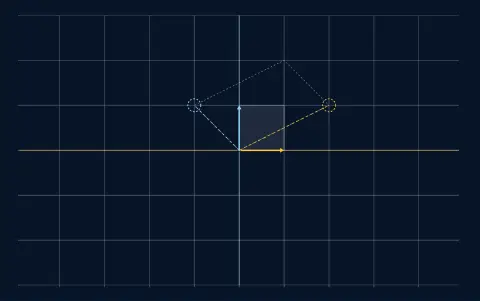
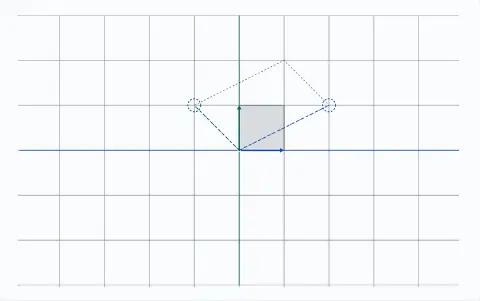
The grid moves under the matrix with columns (2, 1) and (−1, 1), then back under its inverse. Now e1 is at (1, 0) and e2 at (0, 1). A11 a22 minus a12 a21 is 3.The grid moves under the matrix with columns (2, 1) and (−1, 1), then back under its inverse. Now e1 is at (1, 0) and e2 at (0, 1). A11 a22 minus a12 a21 is 3.

Intermediate · 30 minYou are hereRead

The inverse matrix

Watch a matrix move the grid and its inverse move it back, find the inverse two ways, and see when no undo exists.

Animation: LU factorisation on cells, A = (1, 2, 1), (3, 8, 1), (0, 4, 1). L = (1, 0, 0), (3, 1, 0), (0, 2, 1), U = (1, 2, 1), (0, 2, −2), (0, 0, 5). 9 of 9 cells of LU rebuilt, equal to A.Animation: LU factorisation on cells, A = (1, 2, 1), (3, 8, 1), (0, 4, 1). L = (1, 0, 0), (3, 1, 0), (0, 2, 1), U = (1, 2, 1), (0, 2, −2), (0, 0, 5). 9 of 9 cells of LU rebuilt, equal to A.

Intermediate · 25 minYou are hereRead

LU factorisation

Keep the multipliers of elimination and a matrix splits into two triangles, so each new right-hand side costs two quick sweeps, not a new elimination.

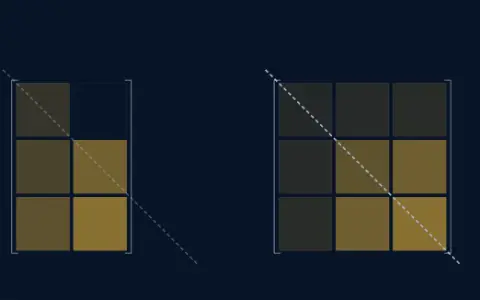
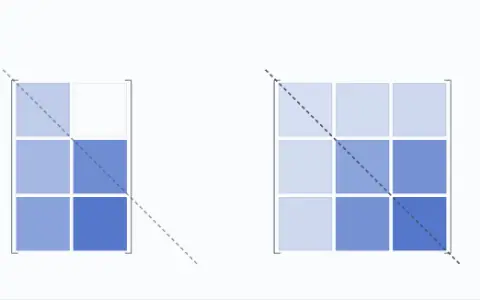
Animation: the matrix A = (1, 2, 3), (0, 4, 5) as cells flips across its diagonal into A transpose. Then A transpose A = (1, 2, 3), (2, 20, 26), (3, 26, 34) flips onto itself, unchanged: it is symmetric. Now: hold.Animation: the matrix A = (1, 2, 3), (0, 4, 5) as cells flips across its diagonal into A transpose. Then A transpose A = (1, 2, 3), (2, 20, 26), (3, 26, 34) flips onto itself, unchanged: it is symmetric. Now: hold.

Intermediate · 25 minYou are hereRead

Transposes and permutations

Flip a matrix across its diagonal, see why the product rule reverses and why AᵀA is symmetric, and reorder a signal with a permutation matrix.

Phasorium

Account

Sign inKeep your place on any device

Subjects

Site

Look