Skip to content

Orthogonality and determinants

Projections and least squares

When a system has no exact solution, the closest one is a projection. This topic drops perpendiculars onto lines and planes, fits a line by least squares, builds orthonormal bases with Gram–Schmidt and QR, and treats functions as vectors.

Lessons on this topic

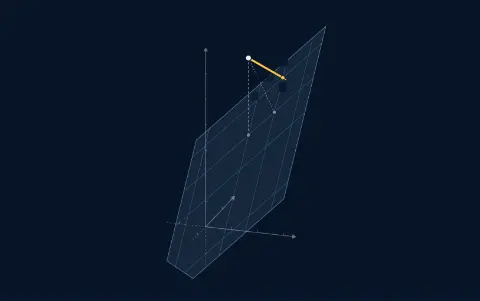
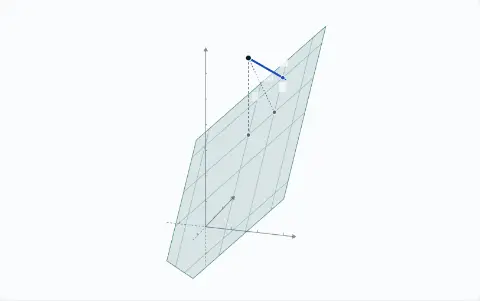
Animation: in a slowly turning 3-D view, the plane b3 = b1 + b2 and the point b = (1, 2, 6). Straight down to (1, 2, 3) is 3 long. A slanted drop to (2, 2, 4) is 2.236 long. The right-angle drop to p = (2, 3, 5) is 1.732 long, the shortest.Animation: in a slowly turning 3-D view, the plane b3 = b1 + b2 and the point b = (1, 2, 6). Straight down to (1, 2, 3) is 3 long. A slanted drop to (2, 2, 4) is 2.236 long. The right-angle drop to p = (2, 3, 5) is 1.732 long, the shortest.

Intermediate · 30 minYou are hereRead

Projections

Find the nearest point of a plane, see why the leftover meets it at a right angle, and build the projection matrix.

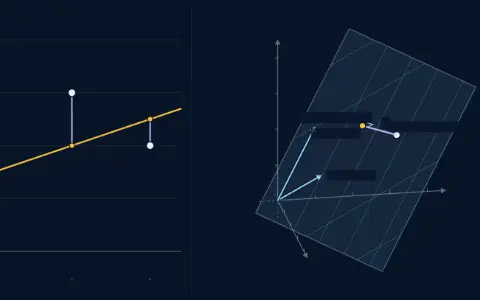
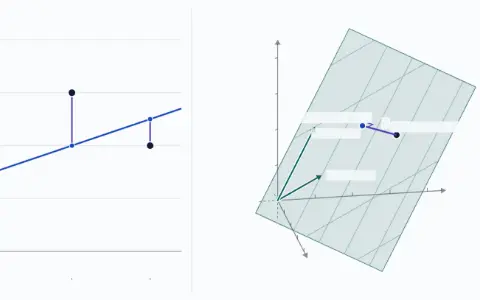
Animation in two panels: the points (0, 1), (1, 3) and (2, 2) with their best line, and the same fit as a point and a plane in 3-D. The line is y = 1.5 + 0.5t. The misses are −0.5, 1 and −0.5, squares adding up to 1.5. In space, p = (1.5, 2, 2.5) is the foot of the right-angle drop from y = (1, 3, 2) to the plane of (1, 1, 1) and (0, 1, 2).Animation in two panels: the points (0, 1), (1, 3) and (2, 2) with their best line, and the same fit as a point and a plane in 3-D. The line is y = 1.5 + 0.5t. The misses are −0.5, 1 and −0.5, squares adding up to 1.5. In space, p = (1.5, 2, 2.5) is the foot of the right-angle drop from y = (1, 3, 2) to the plane of (1, 1, 1) and (0, 1, 2).

Intermediate · 30 minYou are hereRead

Least squares

Fit a line to points no line passes through, see the fit as a shadow, and add a column to fit a parabola.

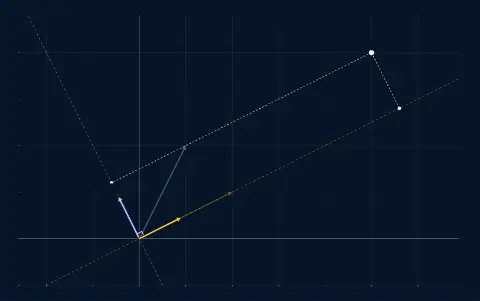
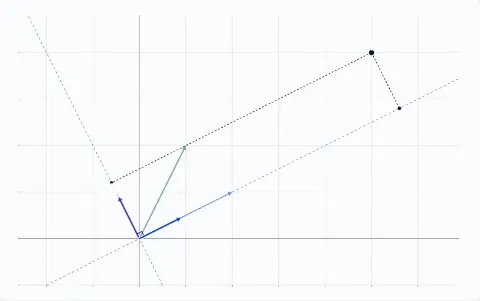
Gram–Schmidt on a1 = (2, 1) and a2 = (1, 2). Q1 = (0.894, 0.447). The leftover (−0.6, 1.2) is at a right angle to q1. Q2 = (−0.447, 0.894). The point (5, 4) has coordinates 6.261 and 1.342 along q1 and q2.Gram–Schmidt on a1 = (2, 1) and a2 = (1, 2). Q1 = (0.894, 0.447). The leftover (−0.6, 1.2) is at a right angle to q1. Q2 = (−0.447, 0.894). The point (5, 4) has coordinates 6.261 and 1.342 along q1 and q2.

Intermediate · 30 minYou are hereRead

Orthonormal bases and Gram–Schmidt

Turn skewed arrows into perpendicular unit arrows by removing shadows, then read any point’s coordinates with dot products alone.

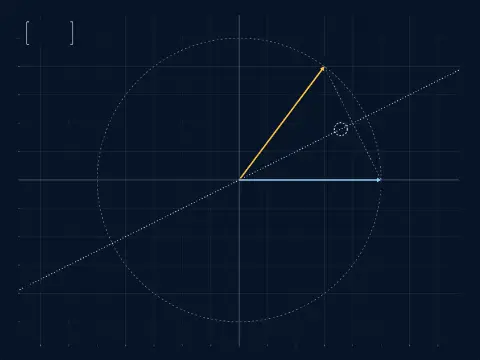
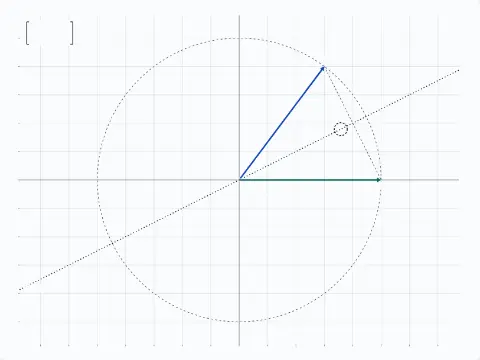
The arrow (3, 4) and its mirror image across a line at 26.57°. The image is (5, 0).The arrow (3, 4) and its mirror image across a line at 26.57°. The image is (5, 0).

Intermediate · 30 minYou are hereRead

QR factorisation

Record the shadows and lengths of Gram–Schmidt and a matrix splits into perpendicular columns times a triangle; then clear a column with a mirror.

Animation: the curve e to the x on minus 1 to 1, and its best fits by a constant, a line, a parabola and a cubic in turn, the gap between them shaded. Now the best cubic: 0.9963 + 0.998x + 0.5367x^2 + 0.1761x^3, gap length 0.0047.Animation: the curve e to the x on minus 1 to 1, and its best fits by a constant, a line, a parabola and a cubic in turn, the gap between them shaded. Now the best cubic: 0.9963 + 0.998x + 0.5367x^2 + 0.1761x^3, gap length 0.0047.

Advanced · 35 minYou are hereRead

Functions as vectors

Treat a curve as a vector with a height at every point, measure angles between curves with an integral, and project e^x onto polynomials.

Phasorium

Account

Sign inKeep your place on any device

Subjects

Site

Look