Skip to content

Eigenvalues and eigenvectors

Eigenvalues

Most arrows change direction under a matrix, but a few only stretch: these are the eigenvectors, and the stretch factors are the eigenvalues. This topic finds them, uses them to take powers of a matrix and to solve linear differential equations, and meets complex eigenvalues and the Jordan form.

Lessons on this topic

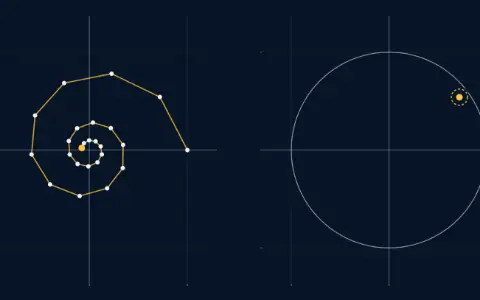
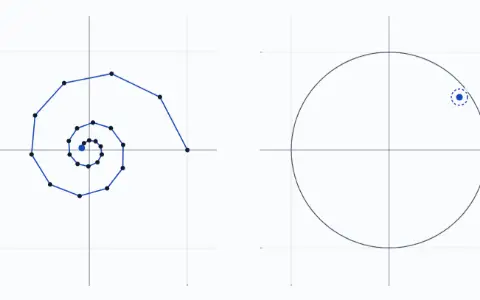
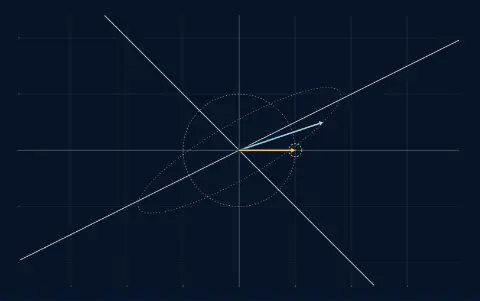
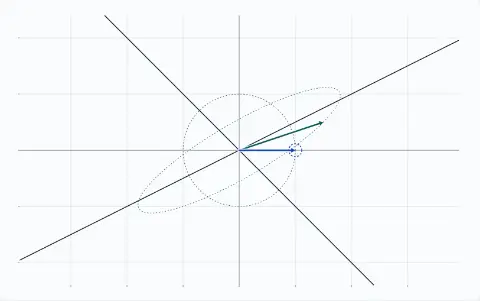
Animation: a unit arrow v sweeps once round the circle while its image Av turns beside it. V points at 0°, v = (1, 0) and Av = (1.5, 0.5). The angle between v and Av is 18.4°. Lines lit: the line at 26.57° with factor 2 and the line at 135° with factor 0.5.Animation: a unit arrow v sweeps once round the circle while its image Av turns beside it. V points at 0°, v = (1, 0) and Av = (1.5, 0.5). The angle between v and Av is 18.4°. Lines lit: the line at 26.57° with factor 2 and the line at 135° with factor 0.5.

Intermediate · 30 minYou are hereRead

Eigenvectors

Sweep an arrow round a circle, find the directions a matrix only stretches and never turns, and read each stretch factor from the picture.

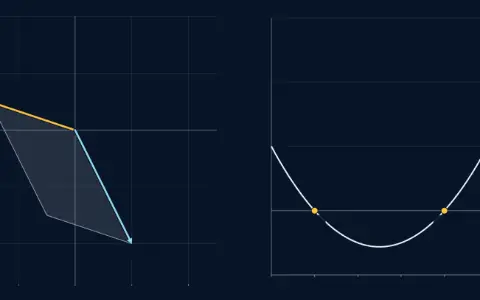
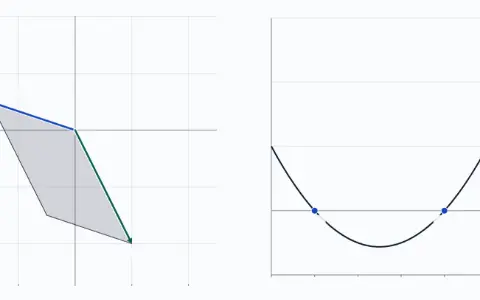
The parallelogram on the columns of A minus lambda I for A = [1.5, 1; 0.5, 1], and a plot of its signed area against lambda. Lambda is 3 and the signed area is 2.5.The parallelogram on the columns of A minus lambda I for A = [1.5, 1; 0.5, 1], and a plot of its signed area against lambda. Lambda is 3 and the signed area is 2.5.

Intermediate · 25 minYou are hereRead

Finding eigenvalues

Slide a number λ until A − λI flattens the plane, turn that into a polynomial equation, and check the roots with the trace and the determinant.

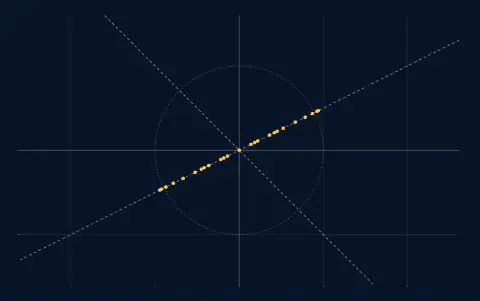
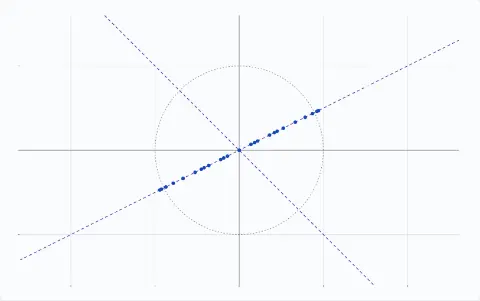
Animation: forty points hit by A = [1.5 1; 0.5 1] again and again, drawn shrunk by 2 to the k. Now k = 10, the cloud is an ellipse along 26.57 degrees. It settles on the line of (2, 1) at 26.57 degrees.Animation: forty points hit by A = [1.5 1; 0.5 1] again and again, drawn shrunk by 2 to the k. Now k = 10, the cloud is an ellipse along 26.57 degrees. It settles on the line of (2, 1) at 26.57 degrees.

Intermediate · 25 minYou are hereRead

Diagonalisation and matrix powers

Split a vector along the eigenvectors, and a matrix applied a hundred times becomes two numbers raised to a power; see where repeated steps lead.

Animation: the population shares of three towns as bars, moving each year by the Markov matrix M. Start (1, 0, 0). Year 10: (0.454, 0.346, 0.2). The steady state is (0.45, 0.35, 0.2).Animation: the population shares of three towns as bars, moving each year by the Markov matrix M. Start (1, 0, 0). Year 10: (0.454, 0.346, 0.2). The steady state is (0.45, 0.35, 0.2).

Intermediate · 20 minYou are hereRead

Markov matrices

Move people between towns by fixed shares, find the steady state as an eigenvector for λ = 1, and see how fast every start reaches it.

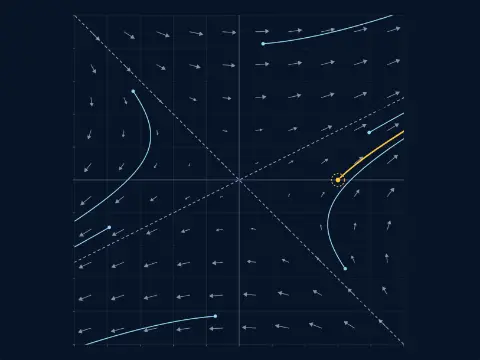
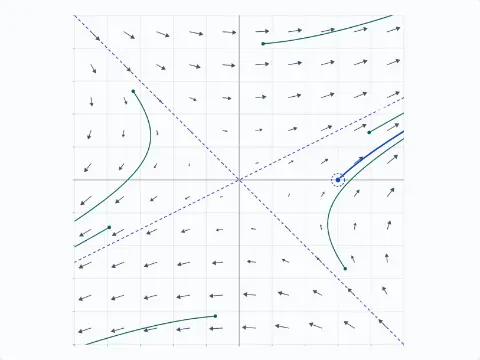
Animation: the velocity field of du/dt = Au for the saddle matrix, with the eigen-lines (2, 1) and (1, −1). Six paths and the path from (3, 0), which is at (109.33, 54.46) at t = 4.Animation: the velocity field of du/dt = Au for the saddle matrix, with the eigen-lines (2, 1) and (1, −1). Six paths and the path from (3, 0), which is at (109.33, 54.46) at t = 4.

Intermediate · 25 minYou are hereRead

Linear differential equations

Follow points as a matrix pushes them through the plane, solve du/dt = Au with eigenvectors, and read stability from the eigenvalues.

Animation: the point (1, 0) moved again and again by the matrix of lambda = 0.72 + 0.54j. 24 steps shown. The complex plane shows lambda with modulus 0.9.Animation: the point (1, 0) moved again and again by the matrix of lambda = 0.72 + 0.54j. 24 steps shown. The complex plane shows lambda with modulus 0.9.

Intermediate · 25 minYou are hereRead

Complex eigenvalues

See why a turning matrix has complex eigenvalues, read their size as the shrink per step and their angle as the turn per step, and connect them to oscillation.

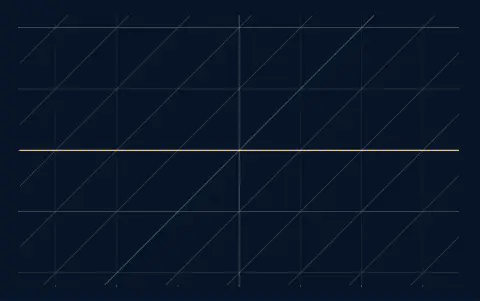
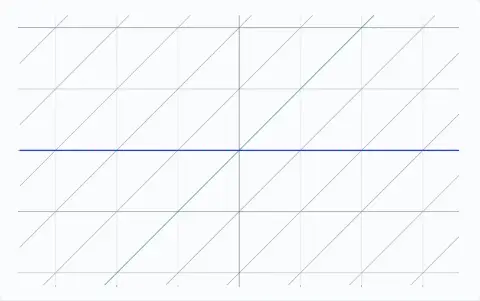
Animation: the grid moved by A(epsilon) = [1 1; 0 1] with its eigenvector lines through (1, 0) and (1, 0). The lines are 0 degrees apart.Animation: the grid moved by A(epsilon) = [1 1; 0 1] with its eigenvector lines through (1, 0) and (1, 0). The lines are 0 degrees apart.

Advanced · 25 minYou are hereRead

Similar matrices and the Jordan form

Watch two eigenvector lines close in and merge, meet the same map written in other coordinates, and see where the Jordan block and its extra factor of t come from.

Phasorium

Account

Sign inKeep your place on any device

Subjects

Site

Look